We are using Asp.Net Chart Controls to create a series of charts from a csv data stream that a user uploads to the server. Until we hit this error "Error executing child request for ChartImg.axd." Since uploading the file is a post-back, we had to change the charting HTTPHandlers.
The solution: open the 'web.config' file, find the line
<add path="ChartImg.axd" verb="GET,HEAD" ...
and add a "POST" verb:
<add path="ChartImg.axd" verb="GET,HEAD,POST" .....
Thursday, March 26, 2009


Tuesday, March 24, 2009
Exchange Server 2007 SP1 Update Rollup 7 due 3/24/09
Microsoft is scheduled to release Update Rollup 7 for Exchange 2007 SP1 today (3/24/09). Based on our review of what's fixed, if you have Entourage clients, expect to do a migration in the next month, or use calendaring, then you should apply this. We will apply this and let you k now if we find anything (if you find anything please post comments!)
Here are some of the calendar-related fixes in the update:
Here are some of the calendar-related fixes in the update:
- OWA and Exchange Web Services (EWS) do not correctly display a monthly/yearly recurring meeting or appointment (KB# 960291)
- Customized properties of a recipient's calendar are removed (KB# 949464)
- Can't read calendar items when some IMAP4/POP3 clients (esp. mobile devices) connect to exchange (KB# 951341)
- Messages Queued for Submission performance counter increases when Domino meeting requests are delivered (KB# 953094)
- You do not receive an NDR after a meeting request was sent after a change to the recipient's LegacyDN (KB# 957124)
And for Entourage:
- The Info store may crash when Entourage client synchs (KB# 957947)
- Unexpected modified instances of recurring meeting (KB# 949113)
- Duplicate Calendar entries (KB# 949114)
Again, this is just a few of the fixes in the update. Read the full KB 960384
Russ
Thursday, March 12, 2009
International Characters and your Migration into Zimbra
We have someone in Switzerland migrating into Zimbra. In this case they're migrating from Meeting Maker.
The appointment at 17h00 should read "Jürg":

The appointment at 17h00 should read "Jürg":

Our prospect ran with these options:
After which his character set conversion issues were no more.
Just to cure your insomnia if it is not already: Meeting Maker server data is stored internally in a Macintosh character set (regardless of what platform you are running on). When we convert Meeting Maker into the intermediate database we convert it into Windows Code Page 1252, Microsoft's default Western European character set (We mainly go to Exchange, after all).
The lower 8 bits with French and German characters should be OK -- but our friends in Switzerland were running with Macintosh clients.
We'll add a UTF-8 option if we get more European demand.
Saturday, March 07, 2009
Mirapoint Calendar migration to Exchange 2007
We've gotten a couple of inquiries out of academe for migrating calendar data out of Mirapoint and into Exchange.

Since we'd done the rough sketch on running Meeting Maker data INTO Mirapoint (though the people who asked for that are now lost at sea), pulling it out and putting it into Exchange did not seem so difficult.
Actually, when we brought it up at our Friday development meeting the Decryption team at Sumatra already had the full spec, and the Insertion team began modifying the existing Oracle Calendar conversion code and... (don't try this at home, kids, we have years of experience that keep us safe from the occasional software fire hazard)... it was basically running by the end of the day.
So we're reading VCS files and converting them into our common intermediate format, and prepping to do all the sorts of things you've come to expect from a Sumatra migration:
- Preserve the recurrence patterns,
- Guest lists
- Guest responses
- Keep meetings "live"
- Avoid conference room anarchy
- Avoid conference room land grabs
- Whatever else you need
Thursday, March 05, 2009
Why would an enterprise user want to print a Silverlight page?
Sumatra is working on a tool to analyze conference room use in Exchange 2007. Sumatra's tool helps facilities managers understand resoure use patterns through 25+ charts and tables. We picked Silverlight as our display engine because it produces the most amazing charts and tables (see below)!
We were days away from a beta-launch, when our QA team decided to print out the entire collection charts. We were stunned when only the first page printed. Looks like Microsoft decided not to include printing in the first two releases of Silverlight. The work-arounds aren't pretty.
Yah, it was nice to see our President's inaugration speech via Silverlight. But does this mean that the only line-of-business apps available to Silverlight are going to be consumer gaming and video-watching apps? Maybe this is the way to make corporate America greener -- prevent enterprise users from printing Silverlight-generated page via the browser?

-RVI
We were days away from a beta-launch, when our QA team decided to print out the entire collection charts. We were stunned when only the first page printed. Looks like Microsoft decided not to include printing in the first two releases of Silverlight. The work-arounds aren't pretty.
Yah, it was nice to see our President's inaugration speech via Silverlight. But does this mean that the only line-of-business apps available to Silverlight are going to be consumer gaming and video-watching apps? Maybe this is the way to make corporate America greener -- prevent enterprise users from printing Silverlight-generated page via the browser?

-RVI
Wednesday, February 25, 2009
Gmail outage. So why put corporate calendars there?
So we run on Exchange and have been leery of entrusting our infrastructure to a company that not only makes the software but hosts, updates, runs, and (pretty much) controls everything that has to do with it except what data we choose to put in and if we want more in this endless fraternity hazing-like ritual of submission and humiliation.
But when GMail was down and Google's response could be summarized as "yep it is" we looked on it with a certain schadenfreude. We've not been encouraging corporations to go to Google Calendar, and we're now less likely to encourage it anytime soon.
Does Exchange ever go down and strand a corporation for hours? Oh yeah -- believe me it does -- and we have the stories. But one Exchange installation going down doesn't bring EVERYBODY ELSE down with it.
To be fair, if you were using Outlook as a client Gmail seems to have worked through the storm, but that's got to be cold comfort to the crew coordinated out of California: "If you used our hated competitor as a front end interface you'd have been fine."
Cloud computing is just not yet a player for serious corporate infrastructure.
Monday, February 23, 2009
Sumatra at NERCOMP March 10, 2009 in Providence, RI
Normally we let the quality of our code and migrations speak for themselves but one of our clients at Wesleyan convinced us to do a talk with them at NERCOMP (The Northeast Regional Computing Program) in Providence, RI in March.
Not surprisingly, the title of our piece of it is: "Migrate your Calendar Data into Microsoft Exchange" on Tuesday morning.
You can see the agenda for the entire conference here.
If you've been wanting to meet Russ (known almost universally among Sumatra clients as "the calm polite one") that would be a good time.
Maybe you can convince him to talk a little bit about what we're doing with conference rooms in Exchange 2007.
Not surprisingly, the title of our piece of it is: "Migrate your Calendar Data into Microsoft Exchange" on Tuesday morning.
You can see the agenda for the entire conference here.
If you've been wanting to meet Russ (known almost universally among Sumatra clients as "the calm polite one") that would be a good time.
Maybe you can convince him to talk a little bit about what we're doing with conference rooms in Exchange 2007.
Wednesday, February 18, 2009
Oracle Connector for Outlook differences from Oracle client and your migration
We take the Oracle Calendar Server export as the definitive source for data that is to be migrated.


As you see above, it keeps on ticking in the OCS client (and will show up in a UNICPOUTU export), but will not be displayed in Oracle Connector for Outlook, as this side-by-side comparison shows:

Sounds pretty reasonable, right?
But now and then Oracle has the same sort of acquired inconsistency syndrome we're used to from Microsoft.
Case in point: in OCS create an appointment
and say you're not going to it:
As you see above, it keeps on ticking in the OCS client (and will show up in a UNICPOUTU export), but will not be displayed in Oracle Connector for Outlook, as this side-by-side comparison shows:
Just so you know.
In these cases our modus operandi is to take the data and display it, since it's a lot easier to remove something you do not want than it is to create all over something you do.
Tuesday, February 10, 2009
Meeting Maker to Apple iCal via Zinsert Field-Proven
We got a call a from a medical school in Silicon Valley asking if we could migrate 2 users out of a Meeting Maker server of 40 into ICS format.
This is not usually cost effective but they just wanted iCalendar files and they were very polite about the request.
Most times this would not be worth mentioning, but they had a novel approach -- they wanted to obsolete their legacy Meeting Maker server ASAP and move on so they took their data from Meeting Maker into Apple iCal before planning on putting it into Zimbra.
The good news: Seems to have worked fine!
To quote their plan:
This is not usually cost effective but they just wanted iCalendar files and they were very polite about the request.
Most times this would not be worth mentioning, but they had a novel approach -- they wanted to obsolete their legacy Meeting Maker server ASAP and move on so they took their data from Meeting Maker into Apple iCal before planning on putting it into Zimbra.
The good news: Seems to have worked fine!
To quote their plan:
...for now it will reside in iCal until Yahoo gets done with the updates that
(we) asked for. Then we will be able to sync iCal to Zimbra.
I really have to give them points for creativity.
Friday, February 06, 2009
Changing your Exchange 2007 resource behavior post-migration
So what happens when you migrate into Exchange 2007 with resources that are scheduled on an on-going basis?
Sumatra Development dogma on this is to have your resource AutoAccept turned OFF (i.e., in E2K7 terms to "AutoUpdate"):

This allows us to control how data gets migrated into Exchange. That is, we reproduce your Meeting Maker data as closely as we can (NB: this is mainly a Meeting Maker migration discussion, Oracle Calendar Server already wisely placed limits on how far ahead in time you can schedule). Interesting trivia: In Meeting Maker you can book a resource into the year 2039, which is an act of either supreme optimism or hubris, take your pick.


Sumatra Development dogma on this is to have your resource AutoAccept turned OFF (i.e., in E2K7 terms to "AutoUpdate"):
This allows us to control how data gets migrated into Exchange. That is, we reproduce your Meeting Maker data as closely as we can (NB: this is mainly a Meeting Maker migration discussion, Oracle Calendar Server already wisely placed limits on how far ahead in time you can schedule). Interesting trivia: In Meeting Maker you can book a resource into the year 2039, which is an act of either supreme optimism or hubris, take your pick.
[PS] C:\Documents and Settings\Administrator> Set-MailboxCalendarSettings cr_testres_1 -AutomateProcessing AutoUpdate -AllowConflicts $TRUE -EnforceSchedulingHorizon $FALSE -ForwardRequestsToDelegates $FALSE -DeleteSubject $FALSE -AddOrganizerToSubject $TRUE -RemoveForwardedMeetingNotifications $FALSE |
So you put your data in and then you want to establish some limits, like only allowing conference rooms to be booked 18 months ahead, and to have them manage themselves to avoid conflicts.

What happens then?
It depends on what happens to the meetings. If you have an ongoing meeting and it does not change, nothing, it will stay there quite happily in everyone's calendar.
If like us you live in the real world and you use the dynamic capability that this gives you, the first major update to an ongoing recurring meeting will cause it to be removed from the resource calendar until you give it an appropriate end date:

Now to proleptically answer the question "Hey, you guys know the start and end dates of all this data -- why don't you set this for us ahead of time?"
It's a fair question. The short answer is because there's so much else going on in a migration that hewing to the line of keeping the data we insert as faithful to what we pulled out is invariably the best course. Letting users learn to deal with the situations they're going to encounter in their new environment is better all around.
Sunday, February 01, 2009
Google Calendaring and Imports
I have got to give Google Calendar some credit.
Since we got asked by a 4,000 user account about moving users into Google Calendar (there's a lesson for you, sinners, you want to get our attention have a 4,000 user migration base), we started looking at moving into Google via iCalendar files.
Most import mechanisms provide the kind of intelligence Geico likes to claim cavemen have, but Google Calendar actually did some checking and gave me the following error message:
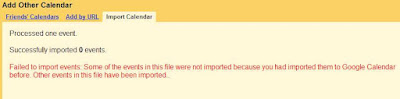 Coolness.
Since we got asked by a 4,000 user account about moving users into Google Calendar (there's a lesson for you, sinners, you want to get our attention have a 4,000 user migration base), we started looking at moving into Google via iCalendar files.
Most import mechanisms provide the kind of intelligence Geico likes to claim cavemen have, but Google Calendar actually did some checking and gave me the following error message:
Coolness.But the cool factor is moderated by my noticing that the interest we've heard is decidedly not from the corporate market. I found 3 Critical Reasons Why Hosted Google Apps Won’t Work for Your Business a really interesting read. Though 10 Reasons Enterprises Aren’t Ready to Trust the Cloud does a good job expanding on it.
I also started looking at the issue of making meetings live when we migrate them over. Moving Gmail calendar to Google Apps For your Domain Calendar goes through the single user procedure, but for a few hundred or more users it would be tedious.
I also can't currently get the meetings to come over with guest lists and responses intact.
Friday, January 30, 2009
Perl script for breaking apart large ICS files for a Zimbra migration
A migration can be really confusing and time-constrained. Since we look at the world through the soda straw of converting calendar data it's easy to sometimes forget there's this whole business of bringing in a new system on (possibly) new hardware, configuring it, provisioning users, training users.... You get the idea.
Sometimes your system is not perfectly tuned and you need to simply get the data in.
Michigan Technical University was having time-outs when trying to load large ICS files into their Zimbra calendars. By large we mean 130,000 to 150,000 lines of iCalendar data.
For a quick fix they produced a Perl script to break the ICS files into smaller chunks. Thanks to Cynthia at MTU we can publish this here for those of you who may need it.
The "splitics.pl" script:
Step 1 - collect the files
Make the ICS files and the zcs script. Some of the ICS files are large.
Put the ics files into a directory, perhaps called "calendar-migration"
Step 2 - Use the splitics.pl script
cd calendar-migration
for i in *.ics; do ../splitics.pl $i; done
Step 3 - create the zcs file to use later
cat *.zcs > /tmp/whole.zcs
Step 4 -
move the "whole.zcs" file to the Zimbra server
suppress resource responses with this command:
zmprov mcr zimbraCalResAutoAcceptDecline FALSE
zmprov -f whole.zcs
Step 5 - undo the suppress responses when ready
NOTE: This script also inserts the tag "mm" to all migrated appointments and meetings.
Sometimes your system is not perfectly tuned and you need to simply get the data in.
Michigan Technical University was having time-outs when trying to load large ICS files into their Zimbra calendars. By large we mean 130,000 to 150,000 lines of iCalendar data.
For a quick fix they produced a Perl script to break the ICS files into smaller chunks. Thanks to Cynthia at MTU we can publish this here for those of you who may need it.
The "splitics.pl" script:
- Splits large calendar ICS files into smaller parts.
- Adds a tag (mm) to all meetings.
Step 1 - collect the files
Make the ICS files and the zcs script. Some of the ICS files are large.
Put the ics files into a directory, perhaps called "calendar-migration"
Step 2 - Use the splitics.pl script
cd calendar-migration
for i in *.ics; do ../splitics.pl $i; done
Step 3 - create the zcs file to use later
cat *.zcs > /tmp/whole.zcs
Step 4 -
move the "whole.zcs" file to the Zimbra server
suppress resource responses with this command:
zmprov mcr zimbraCalResAutoAcceptDecline FALSE
zmprov -f whole.zcs
Step 5 - undo the suppress responses when ready
NOTE: This script also inserts the tag "mm" to all migrated appointments and meetings.
#!/usr/bin/perl # for i in *.ics; do ../splitics.pl $i; done # cat *.zcs > TODO $base_name=$ARGV[0]; $base_name =~ s/.ics$//; open(ZCS,">$base_name.zcs") die "Couldn't open $base_name.zcs : $!\n"; print ZCS "emptyFolder Calendar\n"; last if (/BEGIN:VEVENT/); $headers .= $_; } $file_number=1; $event=$_; while( if (/BEGIN:VEVENT/) { # It's a new event! Yay! if ($event_count > 50) { # See if we should dump the output open(OUTPUT,">$ARGV[0].$file_number") die "Couldn't open $ARGV[0].$file_number for output : $!\n"; print OUTPUT $headers; print OUTPUT $event; print OUTPUT "END:VCALENDAR\n"; close(OUTPUT); # print ZCS "postRestURL Calendar $ARGV[0].$file_number\n"; $file_number++; $event_count=0; $event="BEGIN:VEVENT\n"; } else { # Just keep adding it on $event .= $_; $event_count++; } } else { # It's either the end, or it's another line if (/^SUMMARY:/) { # Tag so we know it's a mm meeting $_ =~ s/$/ \(MM\)/; } $event .= $_; } } # We're at the end of our run... dump what is left over open(OUTPUT,">$ARGV[0].$file_number") die "Couldn't open $ARGV[0].$file_number for output : $!\n"; print OUTPUT $headers; print OUTPUT $event; close(OUTPUT); #print ZCS "postRestURL Calendar $ARGV[0].$file_number\n"; print ZCS "importURLIntoFolder Calendar http://yourserver/ZIMBRA/USERID/$ARGV[0].$file_number/n"; print ZCS "\n"; close(ZCS); |
Sunday, January 25, 2009
Unresponded meeting invitations and your migration
We get this question often enough (at least three separate times from a recent client) that we thought we'd blog on it. They put the statement better than we do:
Short answer: yes.
For completeness, I’ll describe all of the permutations.
If you are a guest, MM records your response.
There are four possible responses to meeting proposals: Accept, Decline, Decide Later, or do nothing.
Will meetings that you have received proposals for, but not responded to
migrate? In other words, if I have been invited to a meeting in Meeting Maker but
not accepted or declined yet will that meeting be migrated?
Short answer: yes.
For completeness, I’ll describe all of the permutations.
If you are a guest, MM records your response.
There are four possible responses to meeting proposals: Accept, Decline, Decide Later, or do nothing.
- If you accept, the meeting WILL appear in your calendar. The meeting request will be removed from your inbox.
- If you decline, the meeting WILL NOT appear in your calendar. The meeting request will be removed from your inbox.
- If you decide later, the meeting WILL appear in your calendar as tentative, and the meeting request WILL remain in your inbox.
- If you do not decide (do nothing), the meeting MAY appear in your calendar as tentative, and the meeting request WILL remain in your inbox. The Sumatra tool does not apply ANY response to the proposal (the tool does not know what your intention was!) However, once you read a meeting proposal, MS Exchange actually forces the meeting to appear in your calendar as tentatively accepted. SO yes, it ‘migrates’.
By the way, there could be instances were the MM exports reports an invalid guest response!! In that case, Sumatra assumes that you have ‘not decided’, and thus leaves the meeting request in the inbox.
The Sumatra rule: Preserve as much information possible. It’s easier for the user to delete something after the migration, than it is to create it.
All of this is for meetings from today forward. In the interests of keeping sanity any unresponded invitations from BEFORE the date of your migration are dropped. If you haven't responded for past meetings by the time of your migration you probably don't want to take it along.
Tuesday, January 20, 2009
Setting the Outlook Delegate Tab Entries in a Migration
As of January 2009 it is possible to set the Delegates in the Outlook Delegate Tab in a calendar migration. This will work for both an Oracle Calendar migration and a Meeting Maker migration. As is our practice for Delegate / Designate / Proxy migrations, we've built it off existing Microsoft-released and supported utilities.
Follow the procedure for PFDAVAdmin as we have previously documented (this sets Permissions on the appropriate folders).
1. Export your Active Directory data using CSVDE
csvde -f ad.csv -s SERVER -d "OU=Clients,DC=ex2007,DC=sumatra,DC=local" -l "dn,cn,displayname,sn,givenname,objectcategory,mailnickname,mail,homeMDB,distinguishedname,altRecipient,targetAddress"
Note: change the -s and the -d to represent your server and your AD
2. Import the data into the Database table AD_ExportUserList (if you have not already)
NOTES: The CSVDE output will:
· Have more columns of data than is used in the table
· A different order of columns. You must move columns in the output file so that the data align with the table
3. Run the macro M_OutputProxyForLDIFDE
4. Open a command window (i.e., DOS) , and run LDIFDE:
ldifde.exe -f proxy_delegates.ldf -i -s SERVER -k
where -s is the name of your server.
Result will be as follows for your Delegates (In Outlook menus via Tools-Options-Delegates Tab):
Follow the procedure for PFDAVAdmin as we have previously documented (this sets Permissions on the appropriate folders).
1. Export your Active Directory data using CSVDE
csvde -f ad.csv -s SERVER -d "OU=Clients,DC=ex2007,DC=sumatra,DC=local" -l "dn,cn,displayname,sn,givenname,objectcategory,mailnickname,mail,homeMDB,distinguishedname,altRecipient,targetAddress"
Note: change the -s and the -d to represent your server and your AD
2. Import the data into the Database table AD_ExportUserList (if you have not already)
NOTES: The CSVDE output will:
· Have more columns of data than is used in the table
· A different order of columns. You must move columns in the output file so that the data align with the table
3. Run the macro M_OutputProxyForLDIFDE
4. Open a command window (i.e., DOS) , and run LDIFDE:
ldifde.exe -f proxy_delegates.ldf -i -s SERVER -k
where -s is the name of your server.
Result will be as follows for your Delegates (In Outlook menus via Tools-Options-Delegates Tab):

For more information on using LDIFDE see:
Using LDIFDE to import and export directory objects to Active Directory
Please note: this will set READ-WRITE (MM Term) permissions only. In Outlook terms it is "Editor."
Why? Because LDIFDE does not let us set READ-ONLY (Outlook term: "Reviewer").
We do the best we can with the Proxy migration tools. In general for setting Delegates we really really really want to be using off-the-shelf Microsoft tools (less chance of an update that makes them obsolete).
Thursday, January 15, 2009
Calendar-only Exchange via a server-side rule
We sometimes get asked about running Exchange in calendar-only mode.
Why would you WANT calendar-only Exchange for some users?
Let's say your legacy calendar-only system is on its way out and you need to get with the times (after Exchange, Zimbra, and Google, are there any other options?). It's easier these days to agree on a unified calendar, but there are departments who will give up their legacy email only when pried from their unconscious fingers.
There's no means in Exchange itself of using only the calendar, but some folks at Illinois State University created a server-side rule for calendar-only Exchange.
See http://www.helpdesk.ilstu.edu/downloads/dl.phtml?id=1042
and http://www.helpdesk.ilstu.edu/kb/index.phtml?kbid=1255
Once I found this I found a variety of other universities had solved the same problem.
Virginia Tech's description goes into how to do this on your own (but they kept it client-side).
And UMichigan produced an entire guide for Exchange administrators.
Kudos to all three (and the others I undoubtedly did not find)!
By the way, [MS-OXORULE]: E-Mail Rules Protocol Specification documents as much as you're likely to need to know at the low level about Rules.
The Big Idea
In general, the idea is to Delete any mail not involved with calendaring AND (this is where things get tricky) have your Exchange configured to copy-forward all email to your non-Exchange account.
Since we find enough folks looking to do this, here's our take on the methodology, with screen shots and everything.
I'm going to take you through how to do this using Outlook Web Access. This has a couple of advantages to it: it's simpler for an end-user to do if they're already Linux-enabled and it automatically makes the rule server-side (which is what you want).
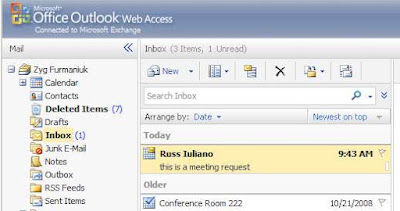
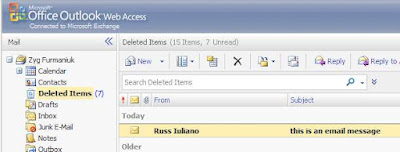
and the email is in Deleted Items. It works.
WHAT REMAINS TO BE DONE
Why would you WANT calendar-only Exchange for some users?
Let's say your legacy calendar-only system is on its way out and you need to get with the times (after Exchange, Zimbra, and Google, are there any other options?). It's easier these days to agree on a unified calendar, but there are departments who will give up their legacy email only when pried from their unconscious fingers.
There's no means in Exchange itself of using only the calendar, but some folks at Illinois State University created a server-side rule for calendar-only Exchange.
See http://www.helpdesk.ilstu.edu/downloads/dl.phtml?id=1042
and http://www.helpdesk.ilstu.edu/kb/index.phtml?kbid=1255
Once I found this I found a variety of other universities had solved the same problem.
Virginia Tech's description goes into how to do this on your own (but they kept it client-side).
And UMichigan produced an entire guide for Exchange administrators.
Kudos to all three (and the others I undoubtedly did not find)!
By the way, [MS-OXORULE]: E-Mail Rules Protocol Specification documents as much as you're likely to need to know at the low level about Rules.
The Big Idea
In general, the idea is to Delete any mail not involved with calendaring AND (this is where things get tricky) have your Exchange configured to copy-forward all email to your non-Exchange account.
Since we find enough folks looking to do this, here's our take on the methodology, with screen shots and everything.
I'm going to take you through how to do this using Outlook Web Access. This has a couple of advantages to it: it's simpler for an end-user to do if they're already Linux-enabled and it automatically makes the rule server-side (which is what you want).
- Start Outlook Web Access, Click Options and select Rules.
- Create a New Rule for Arriving Messages

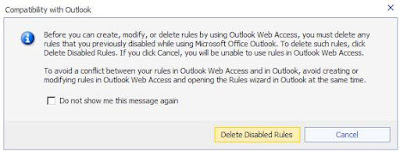
- You will see a warning. Since you want to be calendar-only I cannot see a reason you would want other rules in Outlook -- so nuke away!
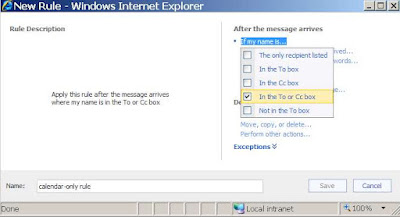
- Let's give this an obvious name like "calendar-only rule" and have it apply if the message is TO you or CC'ing you (you with me so far?):
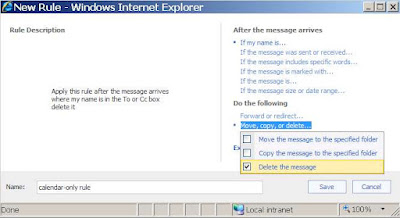
- If any message comes in -- we want to DELETE it
- EXCEPT if it is a meeting invitation or update to a meeting.

- Save it and we are done! (With this part at least -- remember, you need to be configured server-side to copy your email where you want it)
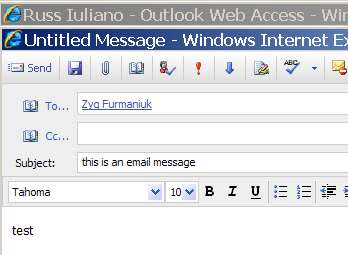
- So NOW let's TEST THIS OUT! Let's have another user (call him "Russ") send email to the poor fellow we modified above (call him "Zyg").
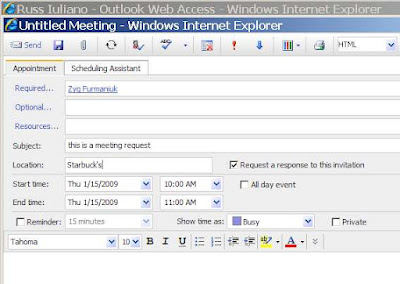
- At the same time let's have Russ send Zyg a meeting invitation:
- Logging into OWA as "Zyg" we see that Zyg has the meeting request in his inbox,
and the email is in Deleted Items. It works.
WHAT REMAINS TO BE DONE
- You still need to have your Exchange ID set up to copy all email to where you really want it. Given the variability in configurations, which is obvious even from the university solutions given above, we do not want to start documenting how to do this in general. There are simply too many ways to skin that cat.
- You can also create a rule client-side using Outlook and then distribute it (we toyed with using Illinois State University's rule, and they kindly sent it to us and would have allowed us to put it up for downloading -- many, many thanks, Randy!). We had not seen a solution involving OWA and wanted to add some knowledge to the discussion rather than refer to someone else's.
Wednesday, January 07, 2009
Setting Default Permissions for Exchange Resources
December, 2008. The subject is migrating proxies from Meeting Maker. Among our clients in December were two sites each with 1000 users, about 100 of which were resources. One had 90,000 proxy objects, the other had 5,000.
Why the 1:18 ratio on what were otherwise similar data sets?
The one with 90,000 proxy objects in Meeting Maker wanted to give everybody in Outlook Delegate access to each resource. In round figures 100 resources times 900 people gives you 90,000 Delegates.
So we were looking at using our usual method for setting Delegates (which would take a long time).
But it's actually simpler than that.
Meeting Maker does not have a default level for giving EVERYONE access to a resource.
BUT Outlook DOES!

And PFDAVAdmin makes it easy to propagate these permissions centrally (so long as you have an Exchange Admin who's willing). In this case it's criminal not to use it.
You can set up an import file as we've documented before, using
\Everyone Reviewer
to provide read-only access.
Or (quoting liberally from the documentation for PFDAVAdmin),
I was going to start taking screen shots of how to do this exactly, when I said to myself, "Self, someone must have already done this."
And so they had. Thank Amit Tank whose FAQ: Give Calendar Read Permission on all Mailboxes - PFDavAdmin admirably takes you through this.
For international users, Set calendar permissions with PFDAVADMIN goes over how to filter for translated "Calendar" folders.
Why the 1:18 ratio on what were otherwise similar data sets?
The one with 90,000 proxy objects in Meeting Maker wanted to give everybody in Outlook Delegate access to each resource. In round figures 100 resources times 900 people gives you 90,000 Delegates.
So we were looking at using our usual method for setting Delegates (which would take a long time).
But it's actually simpler than that.
Meeting Maker does not have a default level for giving EVERYONE access to a resource.
BUT Outlook DOES!
And PFDAVAdmin makes it easy to propagate these permissions centrally (so long as you have an Exchange Admin who's willing). In this case it's criminal not to use it.
You can set up an import file as we've documented before, using
\Everyone Reviewer
to provide read-only access.
Or (quoting liberally from the documentation for PFDAVAdmin),
The Set Calendar Permissions option enables you to perform a bulk edit specifically to change permissions of the Calendar folder so that a single operation can modify the settings of thousands of users on a server. This is useful for changing the default permissions setting of the Calendar folder of all or many users, so that team members can view other member's calendars. Using Microsoft Office Outlook® enables changing only one user at a time, so the Set Calendar Permissions option is a good solution for this kind of task. In addition to changing the permissions of the Calendar folder, by using this option, a bulk-change also occurs on the permissions of the FreeBusy Data folder (hidden folder) of all the users on a server. If the FreeBusy Data folder permissions were not changed, the users will not be able to access another user's calendar.
I was going to start taking screen shots of how to do this exactly, when I said to myself, "Self, someone must have already done this."
And so they had. Thank Amit Tank whose FAQ: Give Calendar Read Permission on all Mailboxes - PFDavAdmin admirably takes you through this.
For international users, Set calendar permissions with PFDAVADMIN goes over how to filter for translated "Calendar" folders.
Monday, January 05, 2009
CorporateTime versions and migration to Exchange / Zimbra
Usually we see Oracle Calendar Server 9.0.4 ("Coca Cola Classic") but one account in the Boston area is running an older CorporateTime server (looks like version 7) to migrate into Zimbra.
Our new version of the conversion code supports this with the following modifications (they're running on a *nix platform):
uniuser -ls -format %s\:%g\:\:%id\:%no -n 588 -p xxxx > /var/tmp/users.txt
unires -ls -n 588 -p xxxx > /var/tmp/resources.txt
unicpoutu "S=LASTNAME/G=FIRSTNAME" -f exp-lastname.txt 588
unires is the older method for getting resource lists. The format is different from OCS 9.0.4, but we've redone the logic in the OraCalReader to take care of it.
Our new version of the conversion code supports this with the following modifications (they're running on a *nix platform):
uniuser -ls -format %s\:%g\:\:%id\:%no -n 588 -p xxxx > /var/tmp/users.txt
unires -ls -n 588 -p xxxx > /var/tmp/resources.txt
unicpoutu "S=LASTNAME/G=FIRSTNAME" -f exp-lastname.txt 588
unires is the older method for getting resource lists. The format is different from OCS 9.0.4, but we've redone the logic in the OraCalReader to take care of it.
Friday, January 02, 2009
Migrating to Exchange: One Summary from the Trenches
In December 2008 we migrated the school of Veterinary Medicine at the University of Illinois.
Craig there sent us a very gracious thank you note (a rare but welcome occurrence in our line of work) that was also a good summary of what to expect in migrating into Exchange from either Meeting Maker or Oracle Calendar.
He has prepared this version for us to publish here:
Craig there sent us a very gracious thank you note (a rare but welcome occurrence in our line of work) that was also a good summary of what to expect in migrating into Exchange from either Meeting Maker or Oracle Calendar.
He has prepared this version for us to publish here:
With the services of Sumatra Development LLC, Illinois Veterinary Medicine has
successfully migrated 150 accounts from a local Meeting Maker server to a shared
campus-wide Exchange resource.Interwoven scheduling among administrators and researchers elevates the data to a critical level of importance for the organization. Migrating data from one proprietary package to another, neither of which is governed by a standards protocol, is unbelievably tricky. Yet we were able to accomplish this migration in a transparent manner that our end users expected. They just wanted it to work and it just worked for us.
Looking back, I'd say the hardest parts were organizing our calendaring accounts and training our user base on Outlook. Not coincidentally, these parts took the longest. I started this project a little apprehensive about working with two organizations (outside vendors from my perspective) with me in the middle.
Sumatra was converting our data and a central campus IT unit was inserting the
data into the Exchange service. I am pleased to say it worked wonderfully. The
Sumatra instructions and data sets were easily managed by the campus Exchange
service managers. A little extra communication on the side and things worked
seamlessly. When we needed people to be there for us, they were there. My
compliments go Sumatra for their care and dedication at what they do.For our part, the role of tirelessly training, establishing resource sharing and
answering the countless questions users come up with when they skip the training
sessions was something we were prepared to handle. The arrangement let us handle
the part we do best and let the calendaring and Exchange experts do their thing.
Friday, December 12, 2008
Meeting Maker Discussion List Closed
The Meeting Maker Discussion List hosted for years at Emory is shut down as of today (not that it's had many postings for the last year or so). They sent out this announcement earlier this week:
Dear MMXP subscribers,
Over the years, this list was a great asset to
those of us who ran Meeting Maker. Over time, the company(s) made
advancements in the support offerings. Thus, we have not needed this list
as much.
Emory has changed direction in how we use calendaring, and
have migrated away from Meeting Maker.
This is to serve notice that this
list
is to be shutdown effective 12/12/08.
Thank you.
Since the world is running ever lower on Meeting Maker, we're very glad that Oracle Calendar migration has stepped in to take its place.
Wednesday, December 10, 2008
Migrating Oracle Calendar Permissions to Exchange Part 2 DIY
So you want to migrate from OCS to Exchange and you can handle your own data migration (i.e., you don't want live meetings or recreated recurrence patterns) but you still want to migrate permissions.
We'll tell you how you can accomplish that using free off-the-shelf tools from Oracle and Microsoft.
The process proceeds in two phases:
The connections between the OCS User Interface and the output are pretty clear.
You have now successfully extracted the data. Part 1 is complete.

So glad you asked. Running our friend PFDAVAdmin and looking at John Lennon,
We'll tell you how you can accomplish that using free off-the-shelf tools from Oracle and Microsoft.
The process proceeds in two phases:
- EXTRACT the permissions data from Oracle
- INSERT the permissions into Exchange
You may need to modify your user names between the first and second step, but if you're handling your own data migration this should not be too difficult. You're also going to have to write your own script to convert the output from the Extract phase to the input for the Insert phase. Since we get these requests from universities and they have lots of undergraduate computer talent that programs in between beer blasts we don't think this will be too difficult.
Extracting permissions data from Oracle Calendar Server
This is done using the OCS tool UNIACCESSRIGHTS. See the Oracle Calendar Reference Manual for your full set of options.
Let's take the example of John Lennon giving permissions to Jerry Garcia. 
Grantee: S=Garcia/G=Jerry/UID=Jerry.Garcia/ID=256/NODE-ID=1 Designate Right: CONFIDENTIALEVENT=REPLY /CONFIDENTIALTASK=NONE /NORMALEVENT=MODIFY /NORMALTASK=NONE /PERSONALEVENT=VIEWTIME /PERSONALTASK=MODIFY /PUBLICEVENT=MODIFY /PUBLICTASK=MODIFY |
You have now successfully extracted the data. Part 1 is complete.
Inserting permissions data into Exchange
This is done using PFDAVAdmin, whose formal name is the Exchange Public Folder DAV-based Administration Tool. You should check out our earlier postings on PFDAVAdmin. First let's say that on Exchange in Active Directory we already have a John Lennon who has created the same Calendar permissions for his co-worker Jerry Garcia. What would those look like in Exchange saved with PFDAVAdmin?
SETACL Mailboxes\john.lennon\Freebusy Data SUMATRA\jerry.garcia Editor NO SETACL Mailboxes\john.lennon\TopofInformationStore\Calendar SUMATRA\jerry.garcia Editor NO SETACL Mailboxes\john.lennon\TopofInformationStore\Tasks SUMATRA\jerry.garcia Reviewer NO |


Your step is to turn your UNIACCESSRIGHTS export into a file of this format that you can IMPORT into PFDAVADMIN to set the ACLs for Exchange. This is not very hard.
Of course it's in our test domain so everything is "SUMATRA," and "TopofInformationStore" should be "Top of Information Store" (but it breaks oddly in Blogger). You might also want to set the INBOX and OUTBOX permissions if you want them to respond to meeting requests for you.
NOTE: Be careful making any modifications to this file – it is very important that it be tab-delimited.
But you get the idea and there is enough information here for you to fly on your own now should you so choose.
Note the key things about this:- With your own scripting the cost to you is zero for additional tools
- It puts the permissions part of the migration entirely within your hands
Subscribe to:
Posts (Atom)