I was working offiste for the last two weeked and missed the story: Microsoft discovered a problem with Outlook 2010's interaction with Exchange 2010 server, and had to retract Update Rollup 4 for Exchange 2010 they released on June 22,2011. KB251545 described the problem: moving or copying public folders didn't work "as expected."
The release was announced on Technet. Here is the new link to download the rollup
BTW, Update Rollup 5 for Exchange Server 2010 Service Pack 1 release remains "on-schedule" for release in August 2011.
Tuesday, August 09, 2011


Wednesday, July 27, 2011
First Field Migration into Zimbra 7 Accomplished
We ran our first field migration into Zimbra 7 this weekend (out of a Meeting Maker legacy system).
We had early reports of problems with recurring meetings in Z7 migrations, but tested well in advance to make sure that did not happen. All is well.
We had early reports of problems with recurring meetings in Z7 migrations, but tested well in advance to make sure that did not happen. All is well.
Thursday, July 21, 2011
Prevent ghost delegates: find (and remove) delegates before terminating user
In a previous post, I outlined a process to find and remove Ghost Delegates from Exchange. (To recap: you turn a delegate a ghost delegate by deleting the account from AD without removing the delegate permissions in Outlook.)
In this post, I'll outline a process that avoids the ghost delegate problem (by finding and removing delegates BEFORE deleting the terminated user's account.) There are two steps: search AD, and then remove the delegates.
The hard part was finding all users that granted delegate rights to the "soon-to-be-deleted-account." I dredged up two "oldies but goodies:" LDIFDE and CSVDE to do a reverse-lookup for a terminated user using the "public delegate" fields:
- PublicDelegates "What mailbox(es) did I give delegate rights to"
- PublicDelegatesBL: "What mailbox(es) am I a delegate of"
Here are both commands:
LDIFDE.EXE -F delegateLDIFDE.TXT -D "OU=TestUsers,DC=myDC,DC=mydomain,DC=com" -L "name,mail,PublicDelegatesBL" -R "(&mail=termuser@mydomain.com)(PublicDelegatesBL=*))"
csvde -f delegateCSVDE.csv -s myDC -l "name,mail,PublicDelegatesBL" -r "(&mail=termuser@mydomain.com)(PublicDelegatesBL=*))"
Note: the LDIFDE command limits the scope of its work to the "OU=TestUsers;" csvde seaches the entire enterprise directory.
Here is an output from LDIFDE, in which we found all of PublicDelegatesBL of "Andre Admin" (it's just Big Boss):

Next, use Glen Scale's powershell code to confirm the terminated user is a delegate, and then remove that user from all accounts he was granted delegate rights. (The following commands were described in a prior post.) Step 7 is where the terminated user is removed as a delegate. I have shown how to display delegates and forwarding rules, just as an FYI.
- set-ExecutionPolicy RemoteSigned -force
- import-Module ./Messageops-Exchange.psd1
- $myCred=Get-Credential -Credential myservice@mydomain.com
- $newprofile=new-messageops.ewsprofile -identity:myservice@mydomain.com -exchangeversion:exchange2010_sp1 -casURL:https://mycas.mydomain.com -Credential:$myCred
- Get-MessageOps.MailboxDelegateReport-p:$newprofile -id:bigboss@mydomain.com
- Get-MessageOps.MailboxDelegateForwardingRules -p:$newprofile -id:bigboss@mydomain.com
- Remove-MessageOps.MailboxDelegate -p:$newprofile -id:bigboss@mydomain.com -DelegateAddress:termuser@mydomain.com
Notes: the "terminated" user is termuser@mydomain.com; the account that granted delegate rights was bigboss@mydomain.com.
I've pulled the URLs and commands into a text file that you can download to simplify typing....
--Russ
p.s.: I tried Exchange Management Shell, using a new Exchange 2010 commandlet: "Get-MailboxFolderPermission." But it was difficult to do a reverse-lookup (i.e., find all users who grated the "terminated user" permissions: I had to type that user's display name correctly or got no hits.... Plus, this commandlet isn't available for Exchange 2007 customers.
Here is how to get Big Boss' permissions:
Get-MailboxFolderPermission -Identity bigboss:\Calendar
FYI, you can set accessrights, particularly editor rights, between "big boss" and "her admin," that you can't do if your end users access their Exchange calendars via OWA (only):
Set-MailboxFolderPermission -Id:bigboss:\Calendar -User:herAdmin -AccessRights:Editor
The Ghost Delegate Exorcist
A Sumatra client called for help - a flood of NDRs were driving their Exchange server to its knees. The problem: a boss granted his admin delegate rights his calendar. Along with that, all calendar-messages were forwarded to to the admin. After the admin left the company, the admin's mailbox was deleted.
All was fine until someone invited the boss to a meeting. The boss received an NDR after the delegate forwarding rule sent that calendar message to the [now deleted] delegate. That NDR calendar message was sent back to the boss which got forwarded to the [still deleted] delegate, which generated another NDR......)
No big deal. They went into the boss' Outlook delegate and tried to remove the delegate, but couldn't -- Outlook reported the delegate was "(not found):"

The delegates are there but you can't delete them. Ghost delegates.....
The root cause: they didn't remove the delegate permissions and forwarding rules before they deleted the admin assistant's mailbox.
In this post, I'll talk about how to rid Exchange of those ghost delegates. In the next post, I'll talk about how to find and remove delegate permissions BEFORE you delete the terminated user's account.
For the curious, Glen Scales blogged about "How to deal with invalid delegates," and "Displaying delegate forward rules." Even better, Glen wrote some powershell code to exorcise our ghost delegate!
Here is what we did to remove the ghost delegates
-Russ
All was fine until someone invited the boss to a meeting. The boss received an NDR after the delegate forwarding rule sent that calendar message to the [now deleted] delegate. That NDR calendar message was sent back to the boss which got forwarded to the [still deleted] delegate, which generated another NDR......)
No big deal. They went into the boss' Outlook delegate and tried to remove the delegate, but couldn't -- Outlook reported the delegate was "(not found):"

The delegates are there but you can't delete them. Ghost delegates.....
The root cause: they didn't remove the delegate permissions and forwarding rules before they deleted the admin assistant's mailbox.
In this post, I'll talk about how to rid Exchange of those ghost delegates. In the next post, I'll talk about how to find and remove delegate permissions BEFORE you delete the terminated user's account.
For the curious, Glen Scales blogged about "How to deal with invalid delegates," and "Displaying delegate forward rules." Even better, Glen wrote some powershell code to exorcise our ghost delegate!
Here is what we did to remove the ghost delegates
- Download and install the Exchange Web Services Managed API
- Create a sub directory, and copy the Microsoft.Exchange.WebServices dll into the directory; Run Exchange Powershell (as administrator), and change to that sub directory.
- Set the execution policy, import the module, and create a credential variable (using your service account): set-ExecutionPolicy RemoteSigned -force import-Module ./Messageops-Exchange.psd1 $myCred=Get-Credential
- Next, define an exchange profile (as above, we provide our service account with impersonation or full access permissions. See our blog post on impersonation in Exchange 2007 or Exchange 2010), and point to our CAS server directly
$newprofile = new-messageops.ewsprofile -identity:mySVCacct@mydomain.com-exchangeversion:exchange2010_sp1 -casURL:https://mycas.mydomain.com -Credential:$myCred
- See the list of valid and invalid (ghost) delegates and rules:
Get-MessageOps.MailboxDelegateReport -p:$newprofile -id:bigboss@mydomain.com
Get-MessageOps.MailboxDelegatesInvalid -p:$newprofile -id:bigboss@mydomain.com
Get-MessageOps.MailboxDelegateInvalidForwardingRules -p:$newprofile -id:bigboss@mydomain.com - Finally, remove invalid forwarding rules, and THEN remove the delegates (in that order!)
Remove-MessageOps.MailboxDelegateInvalidForwardingRules.unsupported -p:$newprofile -id:bigboss@mydomain.com
Remove-MessageOps.MailboxDelegatesInvalid.UnSupported -p:$newprofile -id:bigboss@mydomain.com
-Russ
Sunday, July 10, 2011
Migrating Zimbra Calendar to Hosted Microsoft Exchange
We've been getting a lot of inquiries lately from people wanting to migrate calendars out of Zimbra and into Exchange.
A few quick guidelines:
A few quick guidelines:
- If you have more than 250 users it is cost-effective to use our full-scale migration technology. It's completely server-to-server, leaves end-users out of the loop, and has results as though you've been using Exchange calendaring all along.
- For a few hundred users or under, try our Decaf option. Application here. Documentation here. It's a server-side ICS import to hosted Exchange, and right now it's mainly geared towards Oracle Calendar migrations, but we'll open it up to Zimbra users if we see enough demand.
Monday, July 04, 2011
Exchange 2010 to Google Calendar Server-Side Calendar Migrations
You read that right.
Now that we finally have OAuth for Google working (one of our engineers described Google's documentation as having "duplications, contradictions and gaps in between." I describe it as a "mess") we're inserting calendar data server-side to Google with full-fidelity and no end-user intervention.
Yippee!
We've read the handwriting on the wall and see that there are sites out there looking to bring their calendar data from Microsoft Exchange over to Google and are not thrilled about having to use PSTs to do it (we don't blame you).
If you are contemplating such -- drop us a line. We want some feedback on how you'd like it implemented.
Now that we finally have OAuth for Google working (one of our engineers described Google's documentation as having "duplications, contradictions and gaps in between." I describe it as a "mess") we're inserting calendar data server-side to Google with full-fidelity and no end-user intervention.
Yippee!
We've read the handwriting on the wall and see that there are sites out there looking to bring their calendar data from Microsoft Exchange over to Google and are not thrilled about having to use PSTs to do it (we don't blame you).
If you are contemplating such -- drop us a line. We want some feedback on how you'd like it implemented.
Thursday, June 30, 2011
Our Office 365 Experience Thus Far...
So we've been pretty good letting our readers know that migration performance into both Live @ Edu and Office 365 is about 14% the performance of on-premises Exchange. And then there's the problems with quotas.
That none of this has changed or been addressed through the beta period of O365 should not be surprising to anybody not under the influence of Prozac or electroshock.
In fact, despite bringing this to Redmond's attention, we've gotten zero feedback, seen zero progress, and expect zero results.
Now that Office 365 is out of beta and in the production, plan on all these nagging "problems" getting re-classified as "features."
That none of this has changed or been addressed through the beta period of O365 should not be surprising to anybody not under the influence of Prozac or electroshock.
In fact, despite bringing this to Redmond's attention, we've gotten zero feedback, seen zero progress, and expect zero results.
Now that Office 365 is out of beta and in the production, plan on all these nagging "problems" getting re-classified as "features."
Tuesday, June 28, 2011
Oracle Beehive to Exchange Migration
Zyg was just back from Charlotte, NC and Russ was soon to head out for a while, when we got an inquiry from one of the few third parties we trust to independently run a migration (Kuttig in Germany -- these guys are sharp and efficient, a pleasure to work with).
Turns out that at least one Oracle Beehive site (see: Is Oracle Beehive DBA (Dead Before Arrival)?) wants to migrate to Exchange.
A quick look at the Oracle Beehive Administrator's Reference Guide and our technology convinces me it should be not too difficult to do at the level we do it at: full-state, server-side to server-side.
Summary changes in our usual process:
Use xCalReader's ICS option.
You'll need a USERS.TXT and RESOURCES.TXT, which should come out of the Beehive utilities list_users and list_resources (be careful of format).
And you will need to export the calendars using the export_icalendar function.
Turns out that at least one Oracle Beehive site (see: Is Oracle Beehive DBA (Dead Before Arrival)?) wants to migrate to Exchange.
A quick look at the Oracle Beehive Administrator's Reference Guide and our technology convinces me it should be not too difficult to do at the level we do it at: full-state, server-side to server-side.
Summary changes in our usual process:
Use xCalReader's ICS option.
You'll need a USERS.TXT and RESOURCES.TXT, which should come out of the Beehive utilities list_users and list_resources (be careful of format).
And you will need to export the calendars using the export_icalendar function.
Friday, June 24, 2011
When a user has 15,000+ unread items in the inbox....
We *thought* huge mailboxes (as measured by disk space) could wreak havoc during a migration. Perhaps we are wrong. This is a story about huge inboxes and unread email (the harbinger of problems that plague email systems.)
Last week we moved a client into Exchange 2010 (on-premesis). BUT the Sumatra Exchange insertion tool hung while inserting one user. For hours. Restarting the tool and rebooting boxes didn't help. After much digging we found the problem: that end user had 15,000+ unread emails in her inbox. What was the issue? (no, not why would we migrate a user with 15,000 unread emails in their inbox who probably left the company three years ago....)
The client hit an Exchange threshold. The issue is described in a Microsoft Technet article: Understanding the Performance Impact of High Item Counts and Restricted Views.
The article says: ...In Exchange 2007 ... an acceptable user experience can still be maintained with item counts as high as 20,000 items. We're still researching if that limit changed for Exchange 2010. Our client hit that wall in Exchange 2010.
So who are these big-bad-inbox-boys and girls? Here's a powershell command: (note, I've set a conservative threshold of 10,000 items for just user mailboxes.)
Get-Mailbox -filter {RecipientType -eq "UserMailbox"} -ResultSize unlimited Get-MailboxFolderStatistics where {($_.name -eq "Inbox" -or $_.Name -eq "Calendar") -AND $_.itemsinfolder -ge 10000} sort-object ItemsinFolder -Descending ft Identity,ItemsinFolder,FolderSize
-Russ
Last week we moved a client into Exchange 2010 (on-premesis). BUT the Sumatra Exchange insertion tool hung while inserting one user. For hours. Restarting the tool and rebooting boxes didn't help. After much digging we found the problem: that end user had 15,000+ unread emails in her inbox. What was the issue? (no, not why would we migrate a user with 15,000 unread emails in their inbox who probably left the company three years ago....)
The client hit an Exchange threshold. The issue is described in a Microsoft Technet article: Understanding the Performance Impact of High Item Counts and Restricted Views.
The article says: ...In Exchange 2007 ... an acceptable user experience can still be maintained with item counts as high as 20,000 items. We're still researching if that limit changed for Exchange 2010. Our client hit that wall in Exchange 2010.
So who are these big-bad-inbox-boys and girls? Here's a powershell command: (note, I've set a conservative threshold of 10,000 items for just user mailboxes.)
Get-Mailbox -filter {RecipientType -eq "UserMailbox"} -ResultSize unlimited Get-MailboxFolderStatistics where {($_.name -eq "Inbox" -or $_.Name -eq "Calendar") -AND $_.itemsinfolder -ge 10000} sort-object ItemsinFolder -Descending ft Identity,ItemsinFolder,FolderSize
-Russ
Follow-on to the Headaches of Cloud Migration
As a follow-on to our earlier postings, you might want to check out
http://ferris.com/2011/06/03/moving-to-hosted-exchange-plan-for-hiccups/
There is never a free ride when you move an entire server.
http://ferris.com/2011/06/03/moving-to-hosted-exchange-plan-for-hiccups/
There is never a free ride when you move an entire server.
Friday, June 17, 2011
International Characters and an OCS to Google Calendar Migration
Short story on International characters migrating into Google Calendar from Oracle Calendar: it works.


Thursday, June 09, 2011
Oracle Calendar to Google Calendar - Server-Side Full-State Migration
Let's say you're using Oracle Calendar and, not happy with your current mega-corp, you opt for another one that is at least producing better graphics and walks the walk about this cloud thing.
Our old friend Jimi Hendrix's calendar in OCS

can now be migrated with full state information into this in Google Calendar:
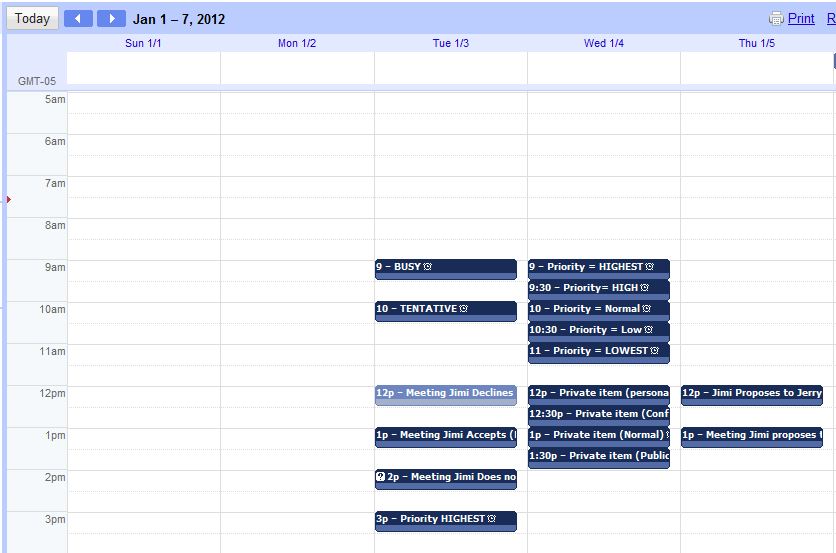
Meetings are meetings with guest lists and status.
This will also work for Zimbra calendaring to Google and Meeting Maker to Google.
We are still working on a few parts of this, but it is now basically completely functional and in two test sites.
One other thing. If you wanted to take all your calendar data from something called Microsoft Exchange and migrate it full-state into Google Calendar, that can be arranged.
June 12: In response to queries. This is all SERVER-SIDE to server-side with no end-user / client-side intervention.
Wednesday, May 25, 2011
Inserting holidays into hosted Exchange without an Outlook client
Holidays.We've been doing them server-side for years now.
So extending Decaf to insert holiday files was not too much of a stretch.
Since we focus on migrating OCS to Exchange, we used the relevant parts of their ICS format for our template.
Create a text file using this template to insert holidays:
This will insert server-side and happen on the given dates, regardless of time zone (!) So a user in the USA or Canada need only put one holiday file together and can use it for all users.
And you go here to insert it. Our usual restrictions apply. Of course UNDO works for this.
As always, any feedback is welcome.
We're debating whether to include an option to insert for all users on a domain -- which is certainly possible but we're a little leery if it's in demand.
So extending Decaf to insert holiday files was not too much of a stretch.
Since we focus on migrating OCS to Exchange, we used the relevant parts of their ICS format for our template.
Create a text file using this template to insert holidays:
| BEGIN:VCALENDAR BEGIN:VEVENT TRANSP:TRANSPARENT SUMMARY:New Year’s Day STATUS:CONFIRMED LOCATION: Any time zone in your system DESCRIPTION: No work day DTSTART;VALUE=DATE:20120101 DTEND;VALUE=DATE:20120101 END:VEVENT END:VCALENDAR BEGIN:VCALENDAR BEGIN:VEVENT TRANSP:TRANSPARENT SUMMARY:Holiday on the 14th STATUS:CONFIRMED LOCATION: Company-Wide DESCRIPTION: Suppose Jan 14 was a holiday in your company DTSTART;VALUE=DATE:20120114 DTEND;VALUE=DATE:20120114 END:VEVENT END:VCALENDAR |
This will insert server-side and happen on the given dates, regardless of time zone (!) So a user in the USA or Canada need only put one holiday file together and can use it for all users.
And you go here to insert it. Our usual restrictions apply. Of course UNDO works for this.
As always, any feedback is welcome.
We're debating whether to include an option to insert for all users on a domain -- which is certainly possible but we're a little leery if it's in demand.
Wednesday, May 18, 2011
Sumatra Decaf: Insert Oracle Calendar ICS into Hosted Exchange
 We made our street cred on full-state migrations server-side to server-side.
But there have been folks who either want to try out just ONE user or go for a simpler migration that trades off full-state migration for something faster and simpler.
This is the reason we've done Sumatra Decaf which we're now happy to open for general inspection at http://www.sumatraresourcewatch.com/decaf
A few things to note:
- This works only for hosted Exchange (e.g., Live at Edu, Office365, BPOS)
- We keep track of the domains that insert and limit it to 5 accounts on that domain by default
- We've geared this to the ICS exports from Oracle Calendar System. Others MIGHT work, but they are a lower priority to us. Each ICS upload is limited to 1 Mb and it inserts only from Today (i.e., the date you are inserting) forward.
- In a few days we'll show you how to use this to insert holidays server-side.
- Read the Help PDF at the site for more information.
Sunday, May 15, 2011
Silverlight web service times out after 60 seconds
For Silverlight apps with web services calls that time out after 60 seconds:
You've set httpRuntime executionTimeout and binding SendTimeout, but your app still times out after 60 seconds. The problem is the CLIENT, not the server, is timing out.
In your Silverlight app, set a timeout after you instantiate your service client. For example, set a 30 min timeout on your service called "mySvc:"
mySvc.ChannelFactory.Endpoint.Binding.SendTimeout = New TimeSpan(0, 30, 0)
You've set httpRuntime executionTimeout and binding SendTimeout, but your app still times out after 60 seconds. The problem is the CLIENT, not the server, is timing out.
In your Silverlight app, set a timeout after you instantiate your service client. For example, set a 30 min timeout on your service called "mySvc:"
mySvc.ChannelFactory.Endpoint.Binding.SendTimeout = New TimeSpan(0, 30, 0)
Friday, May 13, 2011
Creating All Day Events with EWS in Office365
You might remember our recent post:
about the head trip that we went through with migrating all day events into Exchange using EWS and how weirdly the display was different between versions of Outlook and OWA.
Well we're adding this to tell you it's the same head trip in Office365 (no real surprise there but we just feel the need to document it).

Thursday, May 05, 2011
Web-Based, one-step Oracle Calendar to Hosted Exchange migration
This is an early look at something we call Sumatra Decaf and a call for informed consent volunteers.
We've built a really good business out of migrating calendars full-state into Exchange.
But some folks do not need the whole magilla and are just looking for the simplest way of getting data from your legacy system into Exchange in a "good enough" fashion. So we've done that as well.
So yea, we have server-side ICS insertions to Hosted Exchange.
Let's take a look at Puffy Amiumi's calendar in OCS (also in Japanese Standard Time)

Use UNIICAL to export it and then read it into our web-based application (shown here in Alpha):

and in Outlook Web Access on Live at Edu, the results look like this:

Notice we're prefacing them with _TEST_ for the moment to make sure it does not get into the wild before we're ready.
The 5:00 PM Meeting at which Puffy is a guest looks like this in the agenda so that you know who's organized it and who else is supposed to be there.
 Quick, simple, and executable without a lot of prep time.
Now our other option for a migration remains: longer, planned, and full-featured.
We're looking at how we want it to evolve and would welcome some input from you folks.
We're looking at how we want it to evolve and would welcome some input from you folks.
Thursday, April 28, 2011
Progress on migrations to Google Calendar
We're kind of psyched because we've made the first real progress on Oracle Calendar / Meeting Maker / Zimbra full-state migration to (*shudder*) Google Calendar.
Check out this screenshot from our latest tech:

The important thing is the yellow highlighting. Yep -- we got attendees in with their responses.
Now we're working on the mappings and recurrences. So those of you out there stay tuned -- there is light at the end of the tunnel
Check out this screenshot from our latest tech:
The important thing is the yellow highlighting. Yep -- we got attendees in with their responses.
Now we're working on the mappings and recurrences. So those of you out there stay tuned -- there is light at the end of the tunnel
Monday, April 04, 2011
Creating a Room in Office 365 Beta
Working in Office 365 Beta we found it very simple to set up users but a little confusing to set up a Conference Room. So we're documenting the process here. First create the room as though it were a regular old user, like so (you could do all this through PowerShell but I like the simplicity of the Office 365 Admin interface):  Now use PowerShell to set up your session: $LiveCred = Get-Credential This will prompt you for your admin credentials on Office 365. Follow this with the next two commands: $Session = New-PSSession -ConfigurationName Microsoft.Exchange -ConnectionUri https://ps.outlook.com/powershell/ -Credential $LiveCred -Authentication Basic –AllowRedirection and Import-PSSession $Session
  You are now ready to rock and roll by changing your “room” into a ROOM. This PowerShell command will now transform the ID into a Room. Set-Mailbox room222 –Type Room Check this by trying to add it in Outlook:
 And we’re certain that it is now behaving like a room! Since you’re here you might as well also configure the room as you wish. My preference for daily use (though for a calendar migration you’d want to turn OFF AutoAccept): Set-CalendarProcessing -AutomateProcessing:AutoAccept -DeleteSubject:$FALSE -AddOrganizerToSubject:$TRUE -AllowConflicts:$TRUE -EnforceSchedulingHorizon:$FALSE Wash, rinse, and repeat for any other resources you need. When done, be a good doobie and disconnect PowerShell from Office365: Remove-PSSession $Session
Now use PowerShell to set up your session: $LiveCred = Get-Credential This will prompt you for your admin credentials on Office 365. Follow this with the next two commands: $Session = New-PSSession -ConfigurationName Microsoft.Exchange -ConnectionUri https://ps.outlook.com/powershell/ -Credential $LiveCred -Authentication Basic –AllowRedirection and Import-PSSession $Session You are now ready to rock and roll by changing your “room” into a ROOM. This PowerShell command will now transform the ID into a Room. Set-Mailbox room222 –Type Room Check this by trying to add it in Outlook: And we’re certain that it is now behaving like a room! Since you’re here you might as well also configure the room as you wish. My preference for daily use (though for a calendar migration you’d want to turn OFF AutoAccept): Set-CalendarProcessing -AutomateProcessing:AutoAccept -DeleteSubject:$FALSE -AddOrganizerToSubject:$TRUE -AllowConflicts:$TRUE -EnforceSchedulingHorizon:$FALSE Wash, rinse, and repeat for any other resources you need. When done, be a good doobie and disconnect PowerShell from Office365: Remove-PSSession $Session
Monday, March 28, 2011
Oracle Calendar Migrations and Long Resource Names
Kudos to the team at North Dakota State University for finding a bug!
If your Oracle Calendar resource name is longer than 32 characters (and those 32 characters were the same as some OTHER resource's) we weren't handling the error condition gracefully.
That is fixed in version 5.1.01 of xCalReader.
This is probably not an issue for most teams in migration but if you do not have the latest version and want it just contact us.
If your Oracle Calendar resource name is longer than 32 characters (and those 32 characters were the same as some OTHER resource's) we weren't handling the error condition gracefully.
That is fixed in version 5.1.01 of xCalReader.
This is probably not an issue for most teams in migration but if you do not have the latest version and want it just contact us.
Friday, March 25, 2011
Outlook Live URL changes
Quoting from an email Microsoft sent, we want to remind you about upcoming URL requirements for accessing Outlook Live. Due date: June 30, 2011. It's already been extended so now is a good time to get it all done.
URL Changes |
URLs that go directly to Outlook Web App, such as http://outlook.com or http://outlook.com/owa should be changed to go to http://outlook.com/ |
|
If you are using the URL http://outlook.com/ecp to access the Exchange control panel management interface, you will also want to modify that URL to look like this: http://outlook.com/ecp/?realm=contoso.edu. |
Single Sign-On Changes |
Single sign-on solutions using the Live@edu SSO toolkit must make the following changes: |
|
Monday, March 07, 2011
Oracle Calendar / Outlook Free Busy Interchange
Free/Busy Lookups from MS Outlook into Oracle Calendar Server
<><>
Congratulations – you are dropping Oracle Calendar for Exchange. One problem: you need to stage it and you need some kind of connectivity between the two systems. This outlines how you can get Free/Busy lookups in Outlook / Exchange from OCS.
Outlook lets you have Internet Free Busy for Contacts: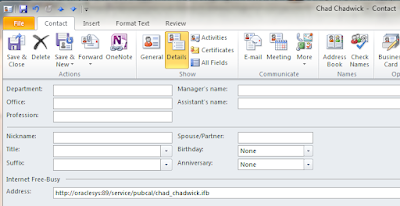
SO: If we can produce IFBs for your OCS users (sorry about all the TLAs here), you can get Free-Busy lookups automatically working for your Outlook users into OCS.
Probably Oracle wanted to avoid exactly what we want in this case.
Not a problem. We can create VFREEBUSY from off the shelf tools in the OCS environment. In particular we will use the utility UNIICAL.
The solution works as follows:
· Select the OCS users you want to have Free-Busy available for in Outlook.
· Set up an internal share that is available to your OCS environment (you will be publishing to it) and your Exchange environment (you will be reading from it)
· One directory call “/…/EXPORT”
· Another directory call “/…/CURRENT”
· A third directory call “/…/IFB”
We’re going to take you through the process for one specific user, who we call Jimi.Hendrix
Create a batch file something like the following:
Uniical –export –u “S=Hendrix/G=Jimi” –f /…/EXPORT/jimi.hendrix.ics -n 1 –end 12/31/2011 –start 10/31/2011 –p PASSWORD |
Notes to this point: The above batch file hardcodes two dates. Obviously we want to make it general to start from TODAY and end at (TODAY + Default F/B Horizon). But let’s start with small ambitions and grow from there.
On a separate computer, we set up a process which interrogates the EXPORT ICS, compares it to the CURRENT ICS (say by comparing the MAX (CREATED) to see if it needs to parse or not), and if so moves it into the CURRENT and parses into an IFB. Practically any scripting language of your choice will work.
So what does ICS look like and what schematic takes it into IFB?
So what does ICS look like and what schematic takes it into IFB?
OCS ICS example
An OCS ICS file has a simple structure with a three-line preface before VEVENTS begin.
WARNING: Experimental evidence has shown that for this to work a contact with Internet Free Busy MUST be in your Contacts folder, not a subfolder, or a folder with any other name. |


Friday, March 04, 2011
New xCalReader for using ICS format to migrate Oracle Calendar
Our latest xCalReader now reads .ics files from Oracle Calendar Server for an Exchange migration:

NB: This is because we've been picking up increasing reports of weirdness with the UNICPOUTU format. We've applied all our usual expertise to the iCal exports: including converting RDATE arrays to real recurrence patterns using RTYPE in Outlook / Exchange.
Also this includes support for Zimbra 6 migration.

NB: This is because we've been picking up increasing reports of weirdness with the UNICPOUTU format. We've applied all our usual expertise to the iCal exports: including converting RDATE arrays to real recurrence patterns using RTYPE in Outlook / Exchange.
Also this includes support for Zimbra 6 migration.
Tuesday, March 01, 2011
New Mantra
Kudos to Russ for our newest mantra:
Hear it once, it's a trick.
Twice it's a special project.
Three times it's a new Sumatra product.
So the topic on the table here is Meeting Maker to Google Calendar migration (with link preservation).
We've had two requests in the last week. Is there anyone else out there?
Hear it once, it's a trick.
Twice it's a special project.
Three times it's a new Sumatra product.
So the topic on the table here is Meeting Maker to Google Calendar migration (with link preservation).
We've had two requests in the last week. Is there anyone else out there?
Sunday, February 20, 2011
More Zimbra 6 to Exchange 2010 / Cloud
So I promised you could see the before and after of contacts and tasks. Here they are.

Migrates to Exchange like this:
 Tasks come over with very few problems. What in Zimbra looks like this

 One thing to keep in mind: Migrating to Live @ Edu is slower than migrating into on-premises Exchange (by a factor of about 7). We're pretty sure it's going to be that way for the foreseeable future.
Migrates to Exchange like this:
 Tasks come over with very few problems. What in Zimbra looks like this
Becomes this in Live @ Edu. It could just as easily be in Outlook -- but we're grooving on someone else keeping an Exchange server running for a change.
 One thing to keep in mind: Migrating to Live @ Edu is slower than migrating into on-premises Exchange (by a factor of about 7). We're pretty sure it's going to be that way for the foreseeable future.
Friday, February 18, 2011
Zimbra 6 to Exchange 2010 calendar migration
It's been a year since Yahoo sold Zimbra to VMware (which reminded me of some of the scenes from prison movies involving cigarettes).
And now is when people are starting to contact us en masse asking if we can move their calendars from Zimbra 6 to Exchange 2010.
Yes, we can.
The way we do it is really convenient. We open the mySQL database and read all the calendar, contact, and task data directly and insert it into Exchange using our usual, field-proven process.
You heard that right: NO user intervention, one spot for an Admin to pull the data and insert the data.


And now is when people are starting to contact us en masse asking if we can move their calendars from Zimbra 6 to Exchange 2010.
Yes, we can.
The way we do it is really convenient. We open the mySQL database and read all the calendar, contact, and task data directly and insert it into Exchange using our usual, field-proven process.
You heard that right: NO user intervention, one spot for an Admin to pull the data and insert the data.
So let's take a look at the BEFORE and AFTER.
Jimi Hendrix's calendar on Zimbra 6.0.7 looks like this:
After extraction and insertion into Live @ Edu it looks as we would expect:
Note, the tentative meeting is tentative, the accepted is accepted, and the declined doesn't appear because that's the way Exchange works. We keep all recurrences and the meetings are completely LIVE on live @ Edu.
But wait -- there's more.
Contacts and Tasks come along for the ride too.
Contacts and Tasks come along for the ride too.
But we'll show you those in a separate posting.
Friday, January 28, 2011
Color-coding your inserted calendar data
Something our QA department has been doing for almost a year now has suddenly struck me as a really really good idea suitable for blogging.
Did you know it's possible to color-code your inserted calendar data?
What amazes me is how simple it is.
In the following example we've inserted several times (with a minimal data set) adding additional digits to our usual Category string:
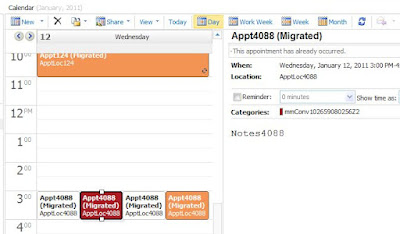
All you need do on an individual basis is Manage the categories (seen here in OWA our client of choice on the Cloud).

Did you know it's possible to color-code your inserted calendar data?
What amazes me is how simple it is.
In the following example we've inserted several times (with a minimal data set) adding additional digits to our usual Category string:
All you need do on an individual basis is Manage the categories (seen here in OWA our client of choice on the Cloud).
You can also use Group Policy to propagate this for everyone if that helps you out. See Configure Categories in Outlook 2007.
Wednesday, January 19, 2011
More on Live @ Edu vs. On-Premises Exchange Speed Differential
Live@EDU | On-Premises |
| ||||
Object Count | 7675 | 7585 |
| |||
Total Time (seconds) | 4193.25 | 597.01 |
| |||
Total Time (minutes) | 69.89 | 9.95 |
| |||
Average Insertion time | 0.55 | 0.08 |
| |||
Mode | 0.41 | 0.05 |
| |||
Median | 0.44 | 0.05 |
| |||
Max | 9.29 | 3.5 |
| |||
Min | 0.10 | 0.03 |
|
So our latest tests on inserting calendar items into Live@Edu vs. inserting into on-premises Exchange gives us a 7:1 time ratio.
That is: it is currently about seven times faster to migrate calendar data into your own Exchange server than it is to migrate it to Live@Edu. We've seen the same data set go far longer, but this is a good estimate to use in your planning purposes. Also yesterday another real-world site reported a figure similar to the one we found.
Just so you know.
Friday, January 07, 2011
Oracle Calendar to Exchange using UNIICAL / ICS formats
Yep. We have a version in-house we're using now -- so if any of you out there want to use ICS files to migrate to Exchange and are willing to be informed consent test sites drop us a line.
Oh yeah, same deal: we re-create meetings with responses and have put in tech to turn RDATE strings into real recurrence patterns (your Outlook client will thank you for that).
Oh yeah, same deal: we re-create meetings with responses and have put in tech to turn RDATE strings into real recurrence patterns (your Outlook client will thank you for that).
Sunday, January 02, 2011
iPhone Alarm Glitch Greets New Year
The title says it all, though the New York Times has some more information.
Apple of course offers no explanation because as all Apple employees know, Apple can do no possible wrong.
Apple of course offers no explanation because as all Apple employees know, Apple can do no possible wrong.
Monday, December 27, 2010
Oracle Calendar / Exchange Free/Busy
An odd combination today here in the Boston-Cambridge area. A request last week for Free/Busy interchange between OCS and Exchange, and a blizzard put one of us into the Zen-like frame of mind to come up with solutions that do not involve lots of custom programming.
If any sites currently in an OCS to Exchange migration with us want to try out Outlook based Free/Busy queries into Oracle Calendar, please drop your Sumatra contact a line.
We are looking for "informed consent experimental subjects."
If any sites currently in an OCS to Exchange migration with us want to try out Outlook based Free/Busy queries into Oracle Calendar, please drop your Sumatra contact a line.
We are looking for "informed consent experimental subjects."
Monday, December 20, 2010
Quotas and Live @ Edu Migrations
The calendar elves were busy this weekend migrating TWO former Oracle Calendar Server sites into Exchange in this Cloud thing.
One went into BPOS (one of the dumbest acronyms EVER!) which is in reality Exchange 2007, which does NOT have submission quotas. (So now you know where this is heading)
The other site went into Live @ Edu which, despite their having had their submission quotas removed for purposes of migration, found the quotas very much in place.
So this is about what you'll see if one of your users hits submission quota in a migration.
One went into BPOS (one of the dumbest acronyms EVER!) which is in reality Exchange 2007, which does NOT have submission quotas. (So now you know where this is heading)
The other site went into Live @ Edu which, despite their having had their submission quotas removed for purposes of migration, found the quotas very much in place.
So this is about what you'll see if one of your users hits submission quota in a migration.

In this example we kept inserting meetings until we hit quota. So one went in fine (you see the guest list and responses) and one did NOT (it says "Invitations haven't been sent for this meeting").
Once your submission quota rolls over (and when is that exactly?) you can send this and it'll go out like a regular meeting invitation. Not fatal in a migration, but we agree, it is darned annoying.
Thursday, December 09, 2010
EWS, Outlook Live, Exchange Release Levels, OWA, and WTF?
Come with us on a journey to mystery.
The subject started out as Holidays but morphed into the more general one of All Day Events (ADEs).
Using EWS, it is possible to insert ADEs and we do LOTS of them in the course of a migration.
BUT, some combination of EWS, Exchange release levels, and OWA are currently giving our usually stable process conniption fits.
Start off with inserting an ADE under either Exchange 2007 rules (with deprecated Time Zone, rules, but bear with us for a moment here) into Live@Edu (not that we have a client trying to do this exactly now or anything like that).
In Outlook attached to Live @ Edu they will appear correctly (as below) if you specify Exchange 2007 SP1. But it will appear as a two day banner if you specify Exchange 2010.
The subject started out as Holidays but morphed into the more general one of All Day Events (ADEs).
Using EWS, it is possible to insert ADEs and we do LOTS of them in the course of a migration.
BUT, some combination of EWS, Exchange release levels, and OWA are currently giving our usually stable process conniption fits.
Start off with inserting an ADE under either Exchange 2007 rules (with deprecated Time Zone, rules, but bear with us for a moment here) into Live@Edu (not that we have a client trying to do this exactly now or anything like that).
In Outlook attached to Live @ Edu they will appear correctly (as below) if you specify Exchange 2007 SP1. But it will appear as a two day banner if you specify Exchange 2010.
 JUST to keep thing really really interesting, viewing the EXACT SAME ADEs in OWA shows the 2007 SP1-defined ADE showing up correctly, and the 2010-defined ADE spanning THREE days:
If your head does not hurt you have not been paying attention.
SO, for the time being while running a holiday insertion with our tools, specify Exchange 2007 SP1. Everything will be hunky-dory.
Don't believe us? Here's the VB .net code (we use Exchange Web Services Managed API v1.1. )
Public Function ewsBuildAllDayEvent() As String
Try
Dim myUserEmail As String = "user10@test.com"
Dim myEWSURL As String = "https://sn1prd0202.outlook.com/EWS/Exchange.asmx"
Dim myExchangeVersion As ExchangeVersion = ExchangeVersion.Exchange2007_SP1
Dim myLogon As String = "admin@test.com"
Dim myPassword As String = "Gu3ssWh0"
'create Service
service = New ExchangeService(myExchangeVersion)
service.Url() = New Uri(myEWSURL)
service.Credentials = New WebCredentials(myLogon, myPassword)
service.ImpersonatedUserId = New ImpersonatedUserId(ConnectingIdType.SmtpAddress, myUserEmail)
'build appointment
Dim appointment = New Microsoft.Exchange.WebServices.Data.Appointment(service)
appointment.subject = "MyTestADE"
appointment.Start = CDate(Now.ToShortDateString)
appointment.End = CDate(DateAdd(DateInterval.Day, 1, Now))
If myExchangeVersion = ExchangeVersion.Exchange2007_SP1 Then
appointment.StartTimeZone = System.TimeZoneInfo.FindSystemTimeZoneById("Eastern Standard Time")
Else
appointment.StartTimeZone = System.TimeZoneInfo.FindSystemTimeZoneById("Eastern Standard Time")
appointment.EndTimeZone = System.TimeZoneInfo.FindSystemTimeZoneById("Eastern Standard Time")
End If
appointment.LegacyFreeBusyStatus = LegacyFreeBusyStatus.Busy
appointment.isalldayevent = True
appointment.Save(SendInvitationsMode.SendToNone)
Return "OK"Catch ex As Exception
Return ("ERROR: " & ex.Message)
End TryEnd Function
Monday, December 06, 2010
Migrating Email? Check out this blog
Frequently we get asked about email.
We do not touch email since we're calendaring guys and enough other people handle email.
But when we see a site that specializes in it and conceptualizes migrations in ways that we ourselves espouse, we just need to let you know.
Such a site is MigrationWiz.
I hate the name (any male who has been a teenager in the USA smirks when the word "wiz" shows up anywhere), but their analyses of email migration are right on.
We do not touch email since we're calendaring guys and enough other people handle email.
But when we see a site that specializes in it and conceptualizes migrations in ways that we ourselves espouse, we just need to let you know.
Such a site is MigrationWiz.
I hate the name (any male who has been a teenager in the USA smirks when the word "wiz" shows up anywhere), but their analyses of email migration are right on.
Thursday, December 02, 2010
Asynchronous Programming
Earlier this week I went to a Microsoft Firestarter Event on Windows Azure. The event was run by a Microsoft Developer Evangelist Jim O'Neil. Jim's talks always inspire me to tweak Sumatra's code bases, ensuring we take advantage of as much of the emerging Microsoft technology as practical. One segment of the day talked about patterns and practices, specifically, the use of asynchronous communication when interacting with cloud (and the web).
They told us about a new Asynchronous Programming module (http://msdn.microsoft.com/en-us/vstudio/async.aspx.) I'm very interested in this because many customers in Sumatra's Education market segment are migrating to Exchange in the Cloud -- Microsoft's
Live@EDU. When inserting lots of data, the variability of "network speed" makes insertion times difficult to predict. We explored changing the Sumatra code to run on multiple threads, but concluded it added more complexity to the code and didn't address the underlying bottleneck: network latency.
What I find interesting about this CTP is that the new async calls have the potential to work around latency issues without increasing code complexity. We'll be testing this in our labs in the next few weeks!
They told us about a new Asynchronous Programming module (http://msdn.microsoft.com/en-us/vstudio/async.aspx.) I'm very interested in this because many customers in Sumatra's Education market segment are migrating to Exchange in the Cloud -- Microsoft's
Live@EDU. When inserting lots of data, the variability of "network speed" makes insertion times difficult to predict. We explored changing the Sumatra code to run on multiple threads, but concluded it added more complexity to the code and didn't address the underlying bottleneck: network latency.
What I find interesting about this CTP is that the new async calls have the potential to work around latency issues without increasing code complexity. We'll be testing this in our labs in the next few weeks!
Thursday, November 18, 2010
Exchange 2010 SP1 Managed API 1.1 released
For the last two weeks I've been puzzled why the installation of the EWS Managed API SDK v1.1 does not install the API library. Turns out it was released today (two weeks after the SDK was released.) Click here for the link to the release blog posting or to the download page.
Friday, November 12, 2010
Exchange 2010 Mapping Users - A Brief Guide
Compared to taking data from a legacy system and putting it into Exchange, you'd think user mapping between the two systems would be pretty easy. Usually it is straight-forward, just incredibly tedious and time-consuming (the occasional input error does not help much).

We design the process so that by the time you've created your intermediate database you should already have the email addresses for these users in the Users table.
So the brief rules are:
 A few other things to keep in mind.
If Oracle Calendar Server IDs are THE SAME as Exchange:
This is a brief guide to user mapping.
Let's say we have three users with the following addresses on Oracle Calendar Server and Exchange:
We design the process so that by the time you've created your intermediate database you should already have the email addresses for these users in the Users table.
So the brief rules are:
- Do NOTHING for OCS email addresses that are the same as in Exchange
- Add entries to the User_Adjusted_Maps table to map OCS accounts that have different Exhcange addresses
- Run the following queries Q_Build_CustIDs_From_MMUserids, Q_Build_CustIDs_AdjustMMUsersids, Q_1_Make_User_Map, FInd duplicates for MM_Exchange_User_Map
- Look at the results in MM_Exchange_User_Map
- Repeat until all of your accounts are done.
A few other things to keep in mind.If Oracle Calendar Server IDs are THE SAME as Exchange:
- Make sure the Primary SMTP or UPN is defined as login@mydomain.com
If Oracle Calendar Server IDs are DIFFERENT from Exchange:
- MAP the differences (Tables)
- Build the mapping table
- Overlay the changes
Once you've got all your users mapped you can just edit the mapping table. But please exercise proper handling and care with it. You do not want to be wondering which version to use when starting yoru migration at midnight on a Friday.
Wednesday, November 10, 2010
UNICPOUTU unreliable in some Oracle Calendar Environments
Let us let you in on one of the open secrets of calendar migration: It's not a wise investment to put a lot of code into pulling data OUT of a legacy system. Better to use one of the utilities the legacy system uses for purposes of upgrading servers or moving users between servers. Less prone to error, it uses the legacy's capability against itself, and it allows a migrator to put their effort into getting the data INTO the target system.
Sometimes though this gets more difficult when there's bugs in the legacy system.
One of our clients (shout out to Matt in North Carolina!), discovered some data missing from the UNICPOUTU export in their Solaris environment.
Quel horreur!
It's been mentioned a little on the OCS boards, but nobody is making a big deal about it and it is unlikely Oracle is going to fix it to make breaking your OCS habit any easier.
Thus far we've seen this ONLY with OCS 10.x on Solaris (all the 9.0.4 migration systems look absolutely peachy and we've been doing 10.x for years with no issues). We suspect it's with the very latest and is more prone to happen when the export is constrained by date (so export everything and let us segment it in our tools).
So as always, keep an eye out.
Sometimes though this gets more difficult when there's bugs in the legacy system.
One of our clients (shout out to Matt in North Carolina!), discovered some data missing from the UNICPOUTU export in their Solaris environment.
Quel horreur!
It's been mentioned a little on the OCS boards, but nobody is making a big deal about it and it is unlikely Oracle is going to fix it to make breaking your OCS habit any easier.
Thus far we've seen this ONLY with OCS 10.x on Solaris (all the 9.0.4 migration systems look absolutely peachy and we've been doing 10.x for years with no issues). We suspect it's with the very latest and is more prone to happen when the export is constrained by date (so export everything and let us segment it in our tools).
So as always, keep an eye out.
Monday, November 08, 2010
Putting Holidays into Live @ Edu Server-Side
We tested our holiday insertion code on Live @ Edu and a list of holidays like this:

Note that this is an All Day Event (and you can specify if the time is to be shown BUSY or FREE):
 While this is an appointment we've put into every calendar without any muss or fuss. You could use the same technology to do that for anything else you want (Shareholder's Meetings, Fire Drills, as your business and imagination dictate).
Any of you who have been through a migration with us know why we keep the "(Migrated)" tags, but you can decide to not use them.
This is scriptable so you can create holidays as you provision users if you have an automated system for so doing.
A few other things to keep in mind:
Note that this is an All Day Event (and you can specify if the time is to be shown BUSY or FREE):
While this is an appointment we've put into every calendar without any muss or fuss. You could use the same technology to do that for anything else you want (Shareholder's Meetings, Fire Drills, as your business and imagination dictate).Any of you who have been through a migration with us know why we keep the "(Migrated)" tags, but you can decide to not use them.
This is scriptable so you can create holidays as you provision users if you have an automated system for so doing.
A few other things to keep in mind:
- This runs as an EWS application from a 32-bit workstation. So all your credentials are completely under your control. If there's demand to run this as an online service we'll listen.
- We take the default time zone of your server for all insertions. If you have users in multiple time zones and want to do this contact us -- that would be a different version.
- You can specify a single user, a list of users, or an LDAP query to handle your insertion.
Friday, November 05, 2010
Handling Conference Rooms in a migration into Exchange

Resources are kind of a pain in the neck in a migration. You want them to take care of themselves when you're done migrating. But to get your data from your old system into your new system with the same state, you're going to need to treat them with kid gloves and lots of TLC.
So we have the following guidelines:
Put all resources in one or more OUs for ease of administration.
PRIOR to migration:
- ENABLE all of the resource accounts via Active Directory Users and Computers
- HIDE the accounts from the GAL
- Configure resources NOT to AutoAccept meetings
AFTER the migration
- Disable the accounts and add them to the GAL
- Configure the resource for AutoAccept (if you desire first-come-first-served functionality) or
- Use group-policy settings for managed rooms and resources
Wednesday, November 03, 2010
Exchange 2010 Permissions for Migration

Impersonation has nothing to do with Frank Gorshin or Rich Little.
It's the permission you need to give your service account to execute a full-state calendar migration.
It's the permission you need to give your service account to execute a full-state calendar migration.
Create a managementRoleAssignment:
new-ManagementRoleAssignment
-Name:_suImp8
-Role:ApplicationImpersonation
-User:'mysvcaccount@mydomain.com'
If you have to ask where you're doing this, please go to your Exchange Administrator.
Subscribe to:
Posts (Atom)